
Gum Therapy & Periodontal Care in Indore
Healthy gums are the biological foundation of every natural tooth. At Ardent Dental Clinic, Dr. Ankita Ruthia treats bleeding gums, bad breath, and advancing periodontitis with targeted ultrasonic debridement, subgingival root planing, and localized antimicrobial therapy—saving natural teeth from bone loss and mobility.
Why Routine Cleaning Isn’t Enough
Preserving the Biological Anchor of Your Natural Teeth
A tooth is only as sound as the foundation supporting it. At Ardent Dental Clinic, Dr. Ankita Ruthia treats periodontal disease not merely as a localized gum problem, but as a chronic bacteriological infection capable of destroying the alveolar bone socket and compromising your systemic health.
When plaque bacteria are left undisturbed along the gumline, they calcify into subgingival calculus (tartar). These rough mineral deposits harbor aggressive anaerobic pathogens that trigger an immune inflammatory cascade. The body’s own defensive enzymes inadvertently dissolve the periodontal ligament (PDL) and crestal bone, creating pathological pockets deeper than 4 mm. Left unchecked, teeth lose their bony foundation, shift, and become loose.
Gingivitis vs. Periodontitis
Gingivitis is reversible swelling of superficial gum margins. Periodontitis is permanent bone loss that requires deep subgingival debridement to arrest progression.
Piezoelectric Cavitation
High-frequency ultrasonic vibrations disrupt microscopic bacterial biofilm and flush deep pockets with antimicrobial coolant without scraping enamel or root dentin.
Systemic Health Connection
Chronic gum inflammation directly impacts diabetic glycemic control and cardiovascular health. Healing your gums lowers circulating systemic inflammatory markers.
6 Signs You May Have Periodontal Infection
Periodontitis is often termed a "silent disease" because it rarely causes sharp pain in its early stages. Recognizing subtle symptoms allows Dr. Ankita Ruthia to intervene non-surgically before permanent jawbone loss causes tooth loss.
Bleeding on Brushing or Flossing
Healthy pink gums never bleed from routine brushing. If you notice blood in your sink or on food, the inner lining of your gum pocket has micro-ulcerations caused by calcified bacterial tartar actively irritating the delicate gingival tissues.
Persistent Halitosis (Bad Breath)
Bad breath that resists tooth brushing and mouthwashes is not a stomach issue—it is caused by volatile sulfur compounds (VSCs) excreted by anaerobic bacteria living deep inside subgingival pockets where oxygen cannot penetrate.
Gum Recession & Exposed Roots
As crestal bone is reabsorbed by chronic inflammation, gum margins recede down the tooth, making teeth appear "longer." Exposed root cementum lacks hard enamel protection, leading to sharp sensitivity to cold air, ice, and sweet foods.
Periodontal Pockets Deeper Than 4mm
Healthy gum sulcus measures 1 to 3 mm deep. When infection destroys periodontal ligament fibers, the pocket deepens to 5 mm, 6 mm, or more. Toothbrushes and dental floss cannot clean deeper than 3 mm, turning deep pockets into sheltered tartar factories.
Loose or Shifting Teeth
When periodontitis destroys more than 40% to 50% of the surrounding jawbone socket, teeth lose their anchor. You may feel teeth jiggle when chewing, notice new gaps opening between front teeth, or feel your bite suddenly change.
Pus Discharge & Swollen Margins
Gums that appear purplish-red, swollen, or puffy, accompanied by a foul taste when pressing against the gumline, indicate active suppuration (pus). This represents an acute infection with high risk of sudden painful periodontal abscess formation.
The 4-Step Periodontal Healing Pathway
Periodontal therapy at Ardent Dental Clinic is systematic, gentle, and biologically driven. Under targeted local anesthesia, we eliminate deep bacterial biofilm without cutting gum tissue or causing post-operative pain.
6-Point Periodontal Probing & Bone Mapping
We begin with a standardized millimeter periodontal probe measuring 6 distinct pocket depths per tooth (mesiobuccal, midbuccal, distobuccal, mesiolingual, midlingual, distolingual). High-resolution digital RVG radiographs evaluate crestal bone height and identify interproximal calculus spurs hiding below the gums.
Ultrasonic Debridement & Root Planing (SRP)
Targeted local numbing gel and precise anesthesia ensure zero pain. Piezoelectric ultrasonic micro-tips deliver gentle high-frequency cavitation, pulverizing tenacious subgingival calculus. Area-specific Gracey micro-curettes gently plane the infected root cementum, producing a biologically clean, glassy-smooth surface.
Subgingival Irrigation & Local Antibiotic Gel
Deep pockets are thoroughly irrigated with warm antimicrobial solution to flush out dislodged bacterial fragments. In persistent pockets exceeding 5 mm, a sustained-release local antibiotic gel (doxycycline or minocycline microspheres) is applied directly into the pocket base, suppressing pathogens for 10 to 14 days.
Tooth Splinting & Tissue Re-Evaluation
For teeth with Grade-I or Grade-II mobility, a flexible fiber-reinforced composite ribbon is bonded across adjacent teeth, distributing bite forces and allowing the supporting periodontium to rest. At 6 weeks, all pocket depths are re-measured to confirm significant pocket reduction and tissue re-adhesion.
Routine Cleaning vs. Deep Root Planing vs. Gum Surgery
Understand the clear clinical differences between preventive surface polishing, deep subgingival debridement (SRP), and advanced surgical periodontal intervention.
| Clinical Criterion | Routine Dental Cleaning | Deep Scaling & Root Planing (SRP) | Surgical Flap Therapy |
|---|---|---|---|
| Primary Treatment Target | Supragingival Tartar Visible plaque and stains above the gumline on crown enamel |
Subgingival Calculus Hard black tartar and bacterial endotoxins adhering to root cementum |
Infrabony Osseous Defects Deep angular bone craters and infected granulation tissue |
| Pocket Depth Range | 1 to 3 mm (Healthy Sulcus) Normal biological depth reachable with daily brushing and flossing |
4 to 7 mm (Active Pockets) Diseased pocket depths where toothbrush bristles cannot reach |
7 mm+ (Advanced Resorption) Severe deep pockets with extensive vertical alveolar bone loss |
| Local Anesthesia Needed | Not Required Completely comfortable without any numbing agents |
Targeted Local Anesthesia Gentle numbing ensures 100% painless deep pocket instrumentation |
Mandatory Local Anesthesia Full quadrant block anesthesia required for surgical incisions |
| Root Planing & Smoothing | No Root Planing Only coronal enamel surfaces are cleaned and polished with airflow |
Meticulous Root Planing Gracey curettes smooth necrotic cementum so gum fibers re-adhere |
Surgical Root Debridement Direct visualization of roots via tissue reflection; bone recontouring |
| Antimicrobial Gel Delivery | Surface Rinse Only Post-cleaning chlorhexidine mouthwash rinse |
Direct In-Pocket Gel Sustained-release antibiotic gel applied directly to deep pocket floors |
Bone Grafts & Membranes Bioactive bone allografts and collagen barrier membranes placed |
| Appointments Required | 1 Visit (30–45 Mins) Completed in a single comfortable clinical session |
1 to 2 Sessions Full-mouth or half-mouth quadrant appointments for thorough care |
Multiple Visits Surgical quadrant phases followed by suture removal at 7–10 days |
| Biological Clinical Outcome | Prevents Gingivitis Maintains existing healthy gum tissue and removes surface coffee/tea stains |
Arrests Bone Loss & Tightens Gums Closes deep pockets, stops bleeding, and saves loose teeth from extraction |
Reconstructs Bone Defect Reduces extreme pocketing when non-surgical therapy is insufficient |
Common Myths About Gum Disease & Deep Cleaning
Misconceptions about gum bleeding and deep cleaning cause many patients to delay treatment until irreversible bone loss occurs. Here is what periodontal science actually demonstrates.
"Bleeding gums are normal if I brush vigorously."
Healthy gingival tissue never bleeds from normal brushing or flossing. Bleeding indicates that subgingival tartar and bacterial endotoxins have ulcerated the delicate internal epithelial lining of your gum pocket. Ignoring bleeding allows infection to migrate deeper into the supporting jawbone.
"Deep scaling and root planing will make my teeth loose."
In severe periodontitis, heavy sheets of calcified tartar act like a false, toxic "bridge" bridging teeth together while quietly destroying the underlying bone. Removing this bacterial cement exposes existing bone loss, allowing the infected gums to heal, shrink, and re-adhere tightly to clean root surfaces.
"Commercial mouthwash and warm salt water can cure gum disease."
Antiseptic mouthwashes and saline rinses only penetrate 1 to 2 mm into the gum sulcus. They cannot dissolve calcified subgingival calculus or eradicate anaerobic colonies thriving in 5mm+ deep pockets. Mechanical ultrasonic debridement is required to physically remove the irritant.
"Periodontal disease only affects older adults."
While chronic periodontitis prevalence increases with age, aggressive periodontitis and moderate gum disease frequently develop in young adults in their 20s and 30s. Genetic predisposition, smoking, high stress, and diabetes can accelerate bone loss rapidly regardless of age.
"Once a tooth is loose from gum disease, it cannot be saved."
Not necessarily. Teeth with Grade-I or Grade-II mobility can often be stabilized. By performing thorough subgingival root planing, relieving excessive biting pressure through occlusal equilibration, and splinting mobile teeth with fiber-reinforced ribbons, natural teeth can be saved for years.
Frequently Asked Questions About Gum Care
Straightforward clinical answers regarding pocket depths, pain control, bone stabilization, and diabetic oral health.
At Ardent Dental Clinic, we maintain strict fee transparency. Periodontal therapy in Indore is typically structured per quadrant or for full-mouth debridement, ranging from ₹1,500 to ₹3,500 per quadrant depending on pocket depth severity, ultrasonic cavitation needs, and local antibiotic gel delivery. Dr. Ankita provides an itemized written estimate following your diagnostic probing chart, with zero hidden chair charges.
No. Routine surface cleanings require no anesthesia, but for deep root planing inside pockets deeper than 4 mm, Dr. Ankita applies a fast-acting topical numbing gel followed by localized anesthesia. This completely numbs the gingival margin and root surface, ensuring 100% painless ultrasonic debridement with zero sharp sensations.
Horizontal bone loss cannot spontaneously regenerate, but thorough scaling and root planing permanently halts further bone destruction and allows the overlying gum fibers to tighten firmly around the roots. In specific vertical or angular infrabony defects, regenerative bone grafting and bioactive collagen barrier membranes can rebuild lost bone support.
For mild-to-moderate generalized periodontitis, treatment is typically completed in 1 to 2 unhurried appointments lasting 45 to 60 minutes each. Treating in half-mouth or quadrant stages allows comfortable local numbing and meticulous subgingival root smoothing without causing patient jaw fatigue.
Diabetes and periodontal disease share a well-documented two-way medical relationship. Elevated blood glucose alters microvascular circulation in the gums, impairing wound healing and encouraging virulent anaerobic bacteria. Conversely, chronic bacterial infection in gum pockets floods the bloodstream with cytokines, worsening insulin resistance. Successful gum debridement frequently helps lower HbA1c levels.
Patients with a history of periodontitis require supportive periodontal maintenance every 3 to 4 months rather than the standard 6-month interval. Periodontal microbiological research confirms that pathogenic anaerobic bacteria repopulate pocket bases within 90 to 120 days. Regular 3-month cleanings prevent reinfection and keep pocket depths under 3 mm.
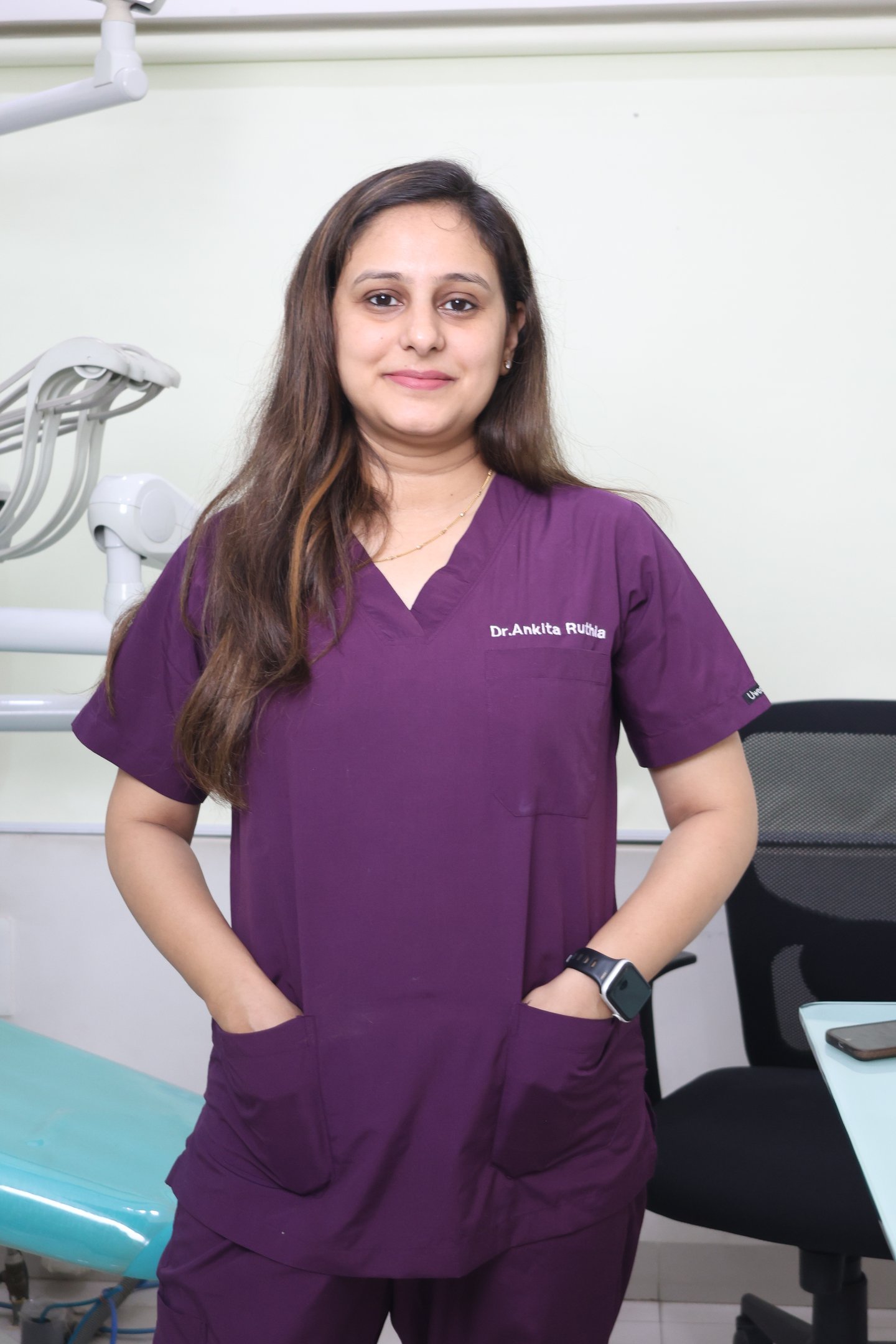
Dr. Ankita Ruthia
With over 15 years of dedicated clinical practice in Indore, Dr. Ankita Ruthia champions conservative periodontal health as the cornerstone of natural tooth longevity. Utilizing gentle piezoelectric ultrasonic debridement, subgingival root smoothing, and localized antimicrobial therapy, every treatment plan is delivered with surgical precision, patient-first comfort, and complete pricing transparency.